OEM Signage Manufacturing: From Design File to Global Delivery
Learn how an OEM signage manufacturer turns design files into finished signs with custom channel letters, LED light boxes, and safe global shipping.
2026/08/27
Reading volume: 1
News Details
Building custom signs for international brands requires precision, smooth teamwork, and reliable factory systems. Whether you are expanding a retail network or managing commercial property designs, working with an experienced OEM signage manufacturer simplifies every stage of production.
This guide breaks down how your vector files transform into high-quality physical products and ship safely to job sites worldwide.
1. File Review and Engineering Translation
The manufacturing process begins when you submit your vector artwork. Engineers carefully analyze your files to verify structural safety and manufacturing feasibility.
During this initial stage, engineers review:
-
Vector File Formats: Processing vector graphics in formats such as AI, EPS, or DXF.
-
Material Selection: Selecting architectural acrylics, aluminum alloys, or stainless steel based on installation needs.
-
Lighting Layouts: Calculating LED placement for uniform brightness across every letter face.
-
Mounting Systems: Planning raceway mounts, flush mounts, or standoffs to fit target wall surfaces.
If your project requires design assistance rather than strict OEM fabrication, opting for ODM signage services lets you refine concepts into finished technical drawings before production begins.
2. Precision Fabrication and Electrical Assembly
Once drawings receive final approval, the factory floor starts converting raw materials into dimensional sign components.
Modern signage production follows five primary steps:
-
Vector Art Approval: Finalizing design specifications and technical blueprints.
-
CNC & Laser Cutting: Cutting sheet metals and acrylics to precise shape measurements.
-
Metal Bending & Welding: Forming letter returns, edges, and outer frames.
-
Surface Finishing: Applying powder coating, painting, or electroplating treatments.
-
LED Assembly: Wiring waterproof modules, drivers, and electrical connections.
Advanced CNC routers and fiber laser cutters shape metal returns and acrylic sign faces with tight tolerances. Automatic channel letter bending machines form clean edges on complex fonts.
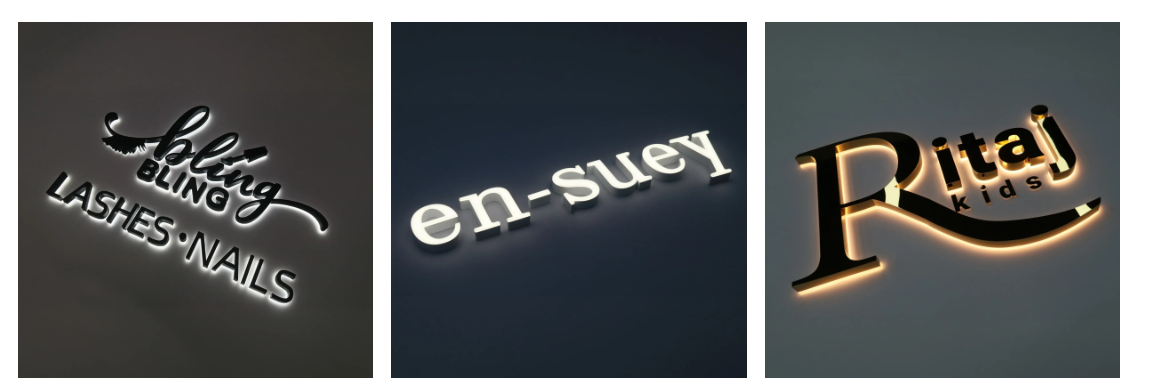
Next, technicians assemble energy-efficient lighting modules. Working with a dedicatedLED channel letter manufacturerensures that all electrical parts use reliable power drivers and certified LED modules.
3. Quality Assurance and Testing
Before any finished sign leaves the factory, it undergoes detailed quality checks. Testing catches minor defects early and ensures full compliance with international safety codes.
-
Burn-in Aging Tests: Illuminated signs remain powered continuously for 24 to 48 hours to check electrical stability.
-
Weather Resistance Checks: Enclosures receive seals and gaskets to satisfy IP65 or IP67 waterproof standards for outdoor environments.
-
Color Temperature Matching: Light meter inspections confirm consistent color temperatures across all sign elements.
When you source private label signs, passing strict testing protects your brand image and prevents costly field repairs.
4. Custom Light Box and Dimensional Sign Fabrication
Different architectural layouts demand varied signage formats. While channel letters highlight brand names on storefronts, flat or projecting displays offer clean, unified surfaces for detailed graphics.
A professional LED light box manufacturer produces diverse configurations:
| Light Box Style | Primary Materials | Ideal B2B Applications |
| Front-lit Fabric / Acrylic | Aluminum frame, UV-printed graphics | Retail store interiors, airport displays |
| Double-sided Blade Signs | Stainless steel, acrylic faces | Pedestrian walkways, shopping center corridors |
| Laser-cut Metal Cabinets | Powder-coated steel, push-through acrylic | Corporate office entrances, exterior building facades |
As a full-service custom sign manufacturer, River Stone builds both individual channel letters and architectural light boxes under one roof, keeping project finishes consistent.
5. Protective Packaging and Global Shipping
Delivering delicate acrylic faces and metal frames across oceans demands sturdy export packaging. Inadequate packaging causes glass breakage, metal dents, or moisture damage during transit.
To prevent freight damage during transit, products move through a multi-layer packaging routine:
-
Layer 1: High-density bubble wrap and protective foam lining.
-
Layer 2: Reinforced corner protectors on all edges.
-
Layer 3: Sealed waterproof plastic wrapping.
-
Layer 4: Custom-built wooden export crates.
Every package uses dense foam wrapping, edge protectors, and custom wooden crates. Freight partners handle logistics via sea, air, or express courier, delivering clear customs paperwork alongside complete installation templates.
Partner withRiver Stonefor Global Signage Projects
Turning design files into installed signage requires steady quality control at every step. By combining advanced machinery, certified electrical components, and secure global shipping, River Stone delivers dependable OEM and ODM signage built to your exact specifications. Contact our team today to start your next B2B custom signage quote.
Share to:


