Types of Business Signage: How to Choose the Right Sign Style for Your Business
News Details
Before a customer walks through the door, every commercial building tells a story, and the sign above the entrance conveys the majority of it. Yet many project buyers start sourcing with only a logo file and a budget, which makes supplier quotes hard to compare. Understanding the main types of business signage and what each style actually does turns that decision into a checklist. This guide compares the sign styles most often used on storefronts, facades, and lobbies, then provides a five-step framework for choosing the right one for your building, brand, and budget.
Storefront Sign Types at a Glance
Most exterior and interior business signs fall into a small number of families. Once you can tell them apart, quotes from different suppliers become much easier to read:
| Sign Type | Illumination | Daytime Appearance | Common Applications |
|---|---|---|---|
| Channel Letters | Internal LED, front or halo | Individual 3D letters | Retail storefronts, restaurants, hotels, corporate facades |
| Lightbox (Cabinet) Signs | Internal LED across the face | Flat illuminated panel | Tenant panels and large-format branding |
| Dimensional / Flat Cut Letters | None; external lighting optional | Raised metal or acrylic letters | Lobbies, offices, boutiques, building addresses |
| Metal Plaques | None | Engraved solid metal plate | Entrances, emblems and commemorative signage |
Illuminated business signs dominate street-facing retail because they remain visible after dark. Non-illuminated styles are suitable for buildings that already have good exterior lighting, pedestrian-focused locations, or projects where illumination is restricted.
Channel Letters: The Most Commonly Specified Storefront Sign
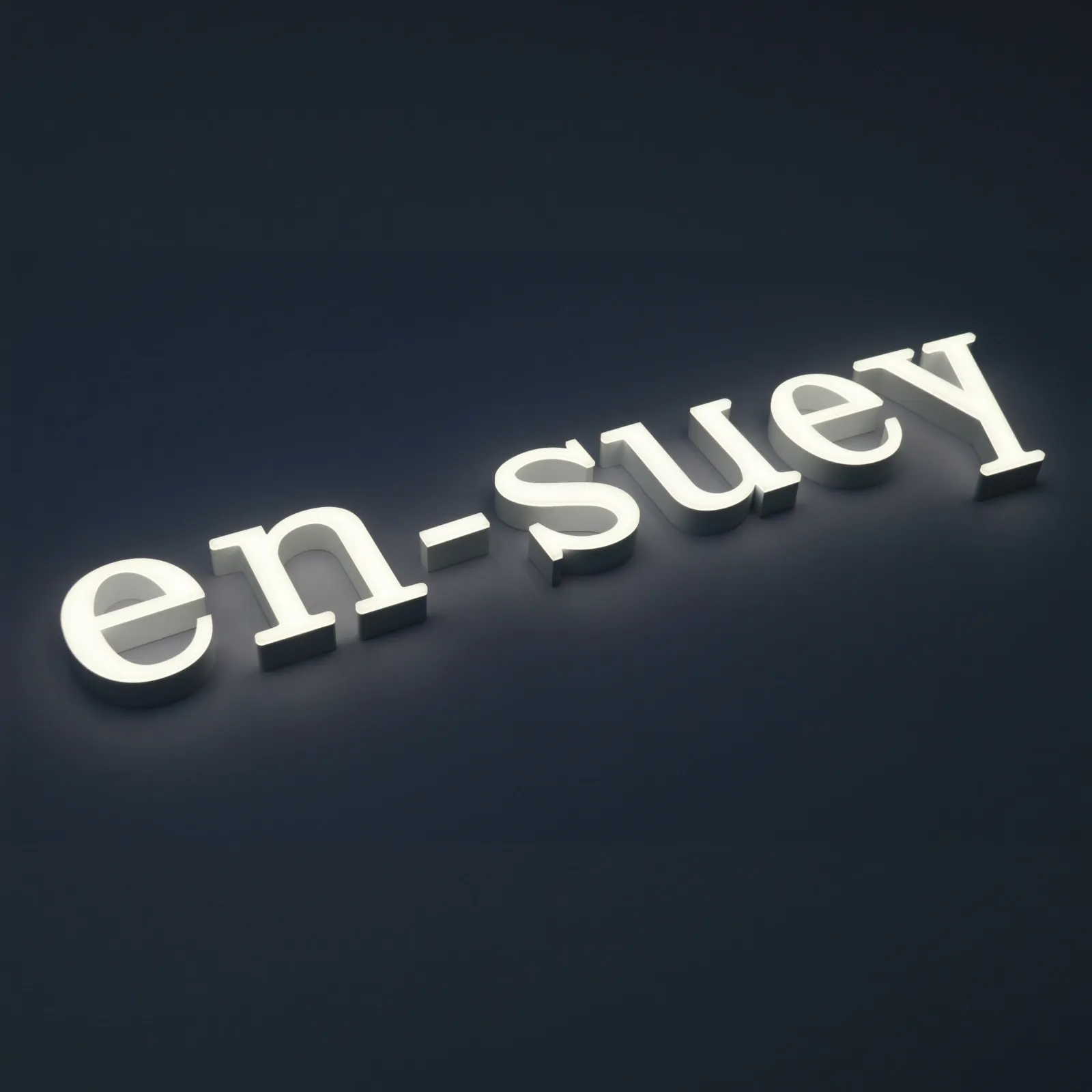
Channel letters are individual three-dimensional letters, each manufactured as a self-contained unit with a metal housing, internal LED modules, and either a translucent acrylic face or an open back. Since each letter is mounted separately, the building surface shows through between them, and the sign appears as part of the architecture rather than a panel bolted on top. Two lighting directions define this category:
Front-Lit Channel Letters
Light shines forward through the acrylic face, making the letter surface itself glow. This is the option with the highest visibility and the standard choice for retail stores, restaurants, and any business competing for attention on a busy street. Trimless versions conceal the metal trim from the front view for a cleaner edge; see an example of trimless front-lit channel letters with a stainless steel housing and optional 304/316 steel.
Halo-Lit Channel Letters
Also called backlit or reverse channel letters, halo-lit versions are mounted on standoffs and direct light backward onto the wall, creating a soft glow around each letter. The daytime look is more architectural, and the nighttime effect more subtle, which is why hotels, high-end restaurants, and corporate lobbies prefer them over full-face illumination.
Dimensional Letters and Metal Letter Signs
When a project does not require illumination, dimensional letters deliver depth and durability with the lowest maintenance. Letters are cut or fabricated from stainless steel, brass, aluminum, or acrylic, then mounted flush to the wall or on standoffs that cast a precise shadow. Solid brass dimensional letters and CNC-engraved plaques display emblems, crests, and fine relief details that illuminated formats cannot reproduce as effectively. Before requesting quotes, compare materials and finishes in the metal letter signs buyer's guide or the flat cut letters and logos guide.
Illuminated or Non-Illuminated Business Signs?
The choice depends on the hours of visibility. If customers pass by after dark, such as in retail, food service, medical, or fitness locations, illuminated business signs keep working around the clock. For LED signage, check the waterproof rating: IP65 is the standard for outdoor use, with IP67 or IP68 available for harsher coastal or industrial environments. Non-illuminated signs are suitable for daytime-focused businesses and buildings where internal illumination is restricted, and they can be paired with external spotlights to gain some night presence without internal wiring.
How to Choose a Sign for Your Business
- Start with visibility distance and traffic speed. Drivers reading at high speed need large, high-contrast lettering, which favors channel letters or a large illuminated face; pedestrian areas can work with smaller dimensional letters.
- Match the style to your brand positioning. Front-lit channel letters project boldness; halo-lit letters and metal letter signs convey precision and a premium, architectural feel.
- Check the building and mounting conditions. Facade material, wall strength, electrical access, and landlord or municipal sign codes all narrow your options before design begins.
- Balance budget against lifecycle cost. LEDs and power supplies are the main service items on illuminated signs. A manufacturer warranty that covers manufacturing defects, including power supplies, for five years eliminates most of that long-term risk.
- Confirm the supplier can provide engineering, not just fabrication. Ask about CNC cutting precision, housing materials such as 304/316 stainless steel, mounting engineering, and packaging for international shipping.
There is no single best sign style, only the best match for a specific building, brand, and budget. Shortlist two or three types from the table above, then request a manufacturability review before committing. River Stone, a custom signage manufacturer serving buyers in more than 40 countries from its Chengdu and Shenzhen facilities, reviews artwork and provides quotes within 24 hours, with typical production lead times of three to seven days.


