What Are the 4 Types of Wayfinding?
Learn the 4 essential types of wayfinding signage—informational, directional, identification, and regulatory. Discover how custom pylon signs, outdoor monument signs, and commercial restroom signs boost navigation and branding for your facility.
2026/08/06
Reading volume: 1
News Details
Navigating a massive corporate campus, a sprawling shopping mall, or a busy multi-story hospital can quickly confuse visitors. When people enter an unfamiliar environment, they rely on visual cues to guide their journey. This structured visual network is known as a wayfinding system.
In modern architectural design, commercial wayfinding signage systems do much more than just post directions. They organize spatial flow, reduce visitor stress, improve physical safety, and strengthen brand equity. Whether a person is searching for an entrance, a specific office suite, or a public facility, wayfinding tools lead the way smoothly.
To build an effective spatial navigation plan, property developers and facility managers break design strategies into four foundational categories:
-
Informational Signage
-
Directional Signage
-
Identification Signage
-
Regulatory Signage
Understanding how these four sign categories interact allows business owners to create seamless visitor experiences. Below, we break down each type of wayfinding, examine real-world applications, and show how high-quality manufacturing improves architectural space navigation.
Understanding the Core Role of Commercial Wayfinding Signage Systems
Before exploring each sign category, it helps to understand why unified navigation matters. First, commercial wayfinding signage systems serve as the silent guides of any built environment. When a customer, job applicant, or delivery driver enters your property, they constantly seek mental answers to four basic questions:
-
Where am I right now?
-
Where is my final destination located?
-
Which exact path should I follow to get there?
-
How will I know when I have safely arrived?
Consequently, an effective navigational plan answers all four questions within seconds. If a sign strategy fails, visitors feel anxious, miss scheduled appointments, or form a negative first impression of the enterprise.
Furthermore, well-planned navigation directly impacts operational business performance. For instance, clear outdoor physical markers reduce vehicle traffic bottlenecks near entry gates. Similarly, clear indoor room markers help employees and guests move through halls without constantly stopping staff members for directions.
However, creating a smooth visual path requires picking the right combination of outdoor architectural physical structures and indoor modular displays. That is why professional planners combine outdoor landmarks like custom structures, interior directories, and room markers into a unified system.
Type 1: Informational Signage and Outdoor Monument Signs for Property Context
The first major category of spatial navigation is informational signage. These displays give visitors general context about where they are within a broad environment. Instead of directing someone to a specific room door, informational signs deliver high-level spatial overviews.
Key Examples of Informational Wayfinding
Informational signs appear right at the start of a user journey. Common examples include:
-
Campus master maps and site diagrams
-
Building directories in main lobbies
-
Parking lot site layout charts
-
Operating hours and facility guidelines
Connecting Informational Signs to Outdoor Monument Signs
When visitors arrive by automobile, their very first visual reference is usually an entrance landmark. As a result, placing robust outdoor monument signs at property entry points sets the immediate baseline for site navigation.
An outdoor monument sign sits low to the ground and delivers solid visual permanence. By displaying property names, street numbers, or multi-tenant brand logos near main road entrances, these outdoor structures confirm to drivers that they have reached the correct physical location.
Design Best Practices for Informational Signage
-
Keep copy concise: Drivers and pedestrians scan information quickly. Use short words and clear, uncluttered fonts.
-
Highlight 'You Are Here': Map boards must feature clear orientation indicators so users can locate themselves instantly.
-
Ensure weather durability: Because outdoor informational signs face rain, UV radiation, and temperature shifts, high-grade metals like stainless steel and anodized aluminum are essential.
Type 2: Directional Signage and Custom Pylon Signs for Seamless Navigation
Once visitors confirm their overall site location, they need active guidance along movement paths. This brings us to the second category: directional signage.
Directional signs keep people moving continuously toward their target destinations. They act as stepping stones along a path, reassuring users at every decision point—such as hallway intersections, elevator lobbies, stairwells, and parking ramps.
Key Examples of Directional Signage
-
Suspended ceiling directional arrows in hallways
-
Wall-mounted directional plaque signs near elevators
-
Wayfinding posts along outdoor pedestrian paths
-
Roadside directional boards for vehicular traffic flow
The Strategic Value of Custom Pylon Signs
For larger commercial developments—such as industrial parks, auto dealerships, and shopping complexes—pedestrian-scale directional signs are not enough. Drivers approaching at high road speeds require early visual cues from long distances.
This is where custom pylon signs play a critical role. Towering high above ground level, custom pylon signs provide tall visual clarity. They display clear arrows, major tenant brand names, and lane directions well before vehicles reach entrance turning lanes.
Moreover, custom pylon signs can integrate dynamic digital LED displays or illuminated light boxes. Therefore, drivers can safely read directional cues during nighttime conditions or heavy storm weather.
Optimizing Directional Flow
To maintain uninterrupted navigation flow:
-
Place signs at decision nodes: Always install a directional sign wherever a hallway splits or a road branches off.
-
Maintain visual consistency: Use uniform color coding, standardized arrow styles, and clear typography throughout the entire journey.
-
Prevent visual clutter: Do not overcrowd a single directional panel with too many destinations. Limit listings to 4–6 key locations per panel for instant recognition.
Type 3: Identification Signage Featuring High-Visibility Commercial Restroom Signs
After following directional arrows through a facility, visitors reach their target destination. At this point, the third category comes into play: identification signage.
Identification signs mark the final end point of a journey. They tell the visitor, "You have arrived." Without clear identification plaques, people hesitate at doors, wonder if they are in the correct place, or accidentally enter private zones.
Key Examples of Identification Signage
-
Corporate office door plaques and department markers
-
Room number plates and employee desk nameplates
-
Warehouse bay identification signs
-
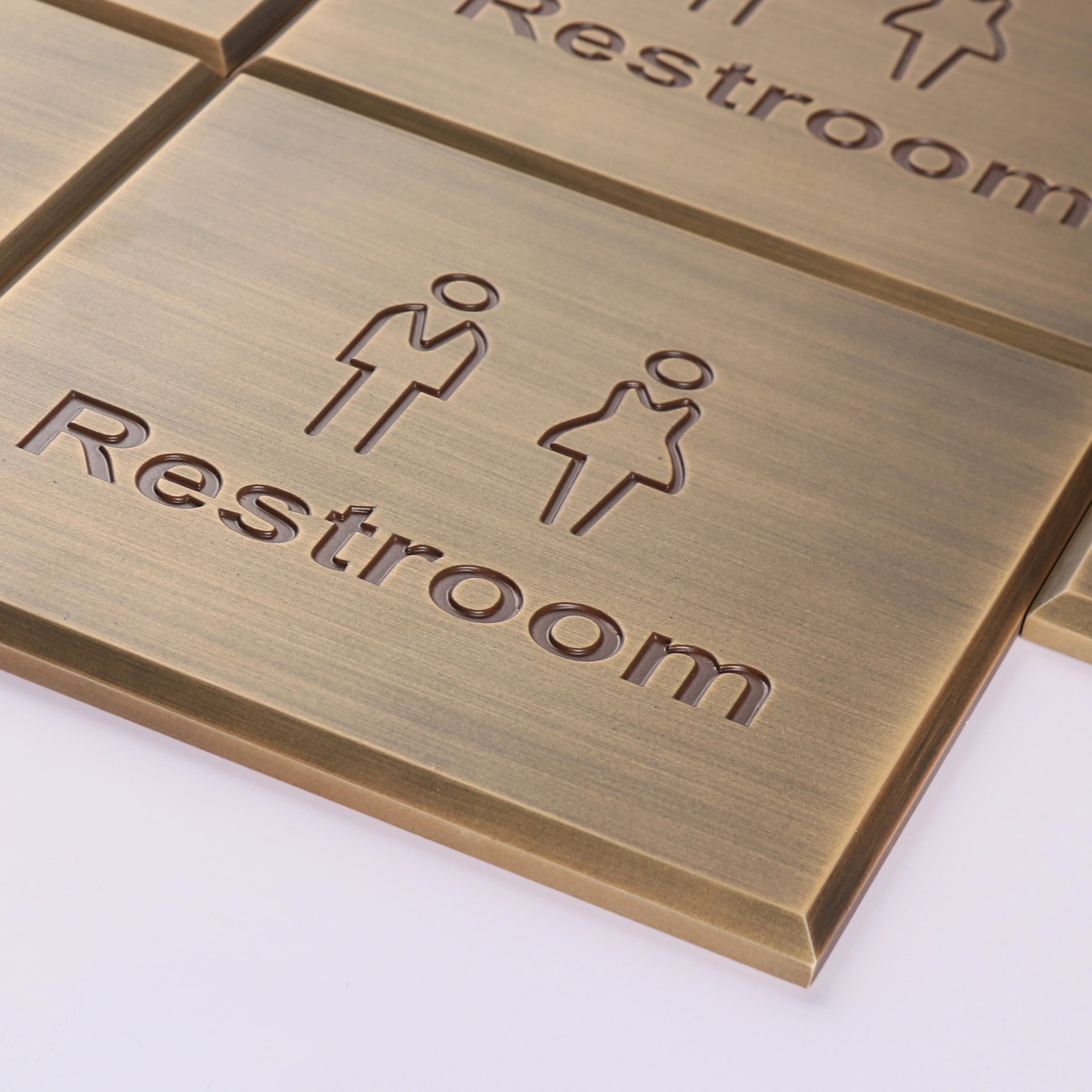
Public facility markers, including commercial restroom signs
Why Commercial Restroom Signs Demand Special Design Focus
Among all indoor identification markers, commercial restroom signs are arguably the most essential. Facility managers frequently underestimate how crucial clear restroom identification is to overall customer comfort.
In public commercial spaces, restroom markers must meet strict accessibility standards while remaining immediately visible down long corridors. In many regions, regulatory codes require specific design standards:
-
Tactile Braille Text: Raised characters and grade 2 Braille ensure visually impaired visitors can identify facilities safely.
-
Standardized Pictograms: Universal male, female, gender-neutral, and wheelchair accessibility symbols communicate facility function instantly across language barriers.
-
High Contrast Colors: High contrast between lettering and background panels helps people with low vision locate facilities quickly.
Enhancing Interior Identification Signage
Beyond regulatory compliance, custom indoor identification markers reinforce brand aesthetics. By using premium acrylics, brushed stainless steel, and precision laser-engraved metals, commercial properties turn basic utility signs into elegant architectural elements.
Type 4: Regulatory Signage for Safety and Facility Compliance
The fourth and final type of navigation marker is regulatory signage. While informational and directional signs focus on guidance, regulatory signs focus on safety, boundary control, and legal compliance.
Regulatory signs inform users about rules, restrictions, and emergency procedures. Consequently, failure to install proper regulatory signage can result in building code fines, legal liabilities, or unsafe emergency situations.
Key Examples of Regulatory Signage
-
ADA compliance accessibility markers
-
Emergency exit signs and fire evacuation maps
-
"No Parking," "Authorized Personnel Only," and "No Smoking" signs
-
Maximum speed limit signs along private facility roads
Balancing Compliance with Architectural Design
Because regulatory signs serve legal safety functions, local building codes strictly govern their mounting heights, font sizes, color contrasts, and placement locations. However, property managers do not need to sacrifice style for compliance. Professional sign manufacturers design custom ADA and regulatory sign lines that match a facility’s broader architectural aesthetic while fulfilling all statutory obligations.
How River Stone Delivers Custom Architectural Wayfinding Solutions
Creating an effective wayfinding strategy requires more than just buying off-the-shelf panels. It demands durable materials, precise custom fabrication, and a unified design concept across all four sign categories.
This is where River Stone (Sichuan River Stone Co., Ltd.) excels. As a premier manufacturer of custom architectural signage systems, River Stone provides complete turnkey fabrication solutions for commercial developments, luxury hotels, corporate campuses, medical facilities, and transportation hubs worldwide.
Comprehensive Product Capabilities
River Stone’s modern manufacturing facility combines advanced laser cutting, multi-axis CNC bending, precision engraving, automatic paint baking, and silk-screen printing. Their extensive commercial catalog includes:
-
Outdoor Monument Signs & Entrance Landmarks: Crafted from weather-resistant stainless steel, aluminum, and stone composite finishes designed to endure harsh outdoor exposure.
-
Custom Pylon Signs & Highway Totems: Tailored structural engineering featuring internal LED backlighting, rust-proof metal framing, and high-impact acrylic faces.
-
Modular Commercial Wayfinding Signage Systems: Coordinated directional boards, wall plaques, and hanging displays that ensure design harmony across multi-building campuses.
-
ADA-Compliant Commercial Restroom Signs & Tactile Room Plaques: Precision-molded Braille and raised character signs crafted to meet worldwide accessibility standards.
Why Global Clients Choose River Stone
-
One-Stop Custom Manufacturing: From technical drawing reviews to full-scale metal fabrication and assembly, River Stone handles every step under one roof.
-
Architectural Material Variety: Clients can select from brushed stainless steel, anodized aluminum, brass, acrylic, composite panels, and energy-efficient LED modules.
-
Rigorous Quality Control: Every outdoor monument, pylon frame, and interior plaque undergoes strict finish and structural testing before international delivery.
By partnering with an experienced direct factory manufacturer like River Stone, architects and project managers can bring complex spatial navigation plans to life—
Share to:


