How Custom Wooden Crating Protects International Signage Shipments
wooden crate
2026/09/30
Reading volume: 2
News Details
The logistics involved in shipping signage internationally requires far more meticulous handling than domestic delivery. Signs undertake extensive journeys, transported by truck, sea freight, warehouse handling, and final delivery vehicles. Throughout this transit, they are subjected to vibration, stacking pressure, moisture, rough handling, and extended periods in transit.
For B2B buyers, contractors, signage companies, hotels, retail brands, and commercial project stakeholders, robust packaging is far from a trivial detail. It safeguards the product, the project schedule, and the final installation quality.
At River Stone, custom signs such as stainless steel lettering, freestanding metal characters, and non-illuminated signage are fabricated to align precisely with each project's requirements. Correspondingly, packaging must also be tailored to the sign. A custom wooden crate is an effective measure to maintain sign integrity from the factory floor to the installation site.
The Imperative for Sturdy Export Packaging for Signage
Custom signs are not ordinary flat commodities. Many signs feature polished surfaces, painted faces, sharp edges, welded bases, raised lettering, or delicate finishes. Consequently, standard cardboard cartons often provide insufficient structural support for long-haul transportation.
For instance, custom freestanding stainless steel letters may incorporate mirror-polished surfaces and integrated base plates. These components necessitate stable support during transit. If they shift within the packaging, they can rub, deform, or sustain scratches.
Furthermore, non-illuminated signs may comprise metal characters, plaques, acrylic components, threaded studs, mounting spacers, and installation templates. Each component must remain secured and protected.
Robust export packaging aids in minimizing transit damage and simplifies cargo handling upon arrival.
Defining a Custom Wooden Crate
A custom wooden crate is a robust shipping enclosure engineered to precisely conform to the dimensions, weight, and configuration of the sign. Unlike generic boxes, it is constructed around the product itself.
The crate may incorporate wooden panels, internal framing, foam cushioning, corner protectors, strapping, plastic sheeting, moisture barriers, and legible labeling. For larger signs, the crate might also include forklift access feet or a palletized base.
Given the unique nature of each signage project, the crate must complement the product. A small desktop sign may require compact bracing. A substantial metal wall sign may demand a reinforced frame. An elongated sign may necessitate additional lateral rigidity to prevent bending.
This tailored approach significantly reduces the likelihood of the sign shifting during handling and ocean freight.
How Wooden Crating Mitigates Shipping Damage
The majority of transit damage arises when goods shift, collide, abrade, or bear pressure at unsuitable points. A wooden crate mitigates these risks through several mechanisms.
Initially, it provides a rigid external shell for the sign, offering protection against impacts during loading and unloading operations.
Secondly, it immobilizes the sign. Internal foam, strapping, and support structures prevent component movement within the crate.
Thirdly, it distributes pressure more uniformly. This is critical when crates are stacked or maneuvered via forklift.
Additionally, wooden crates shield sign corners and polished faces. For metal signs, corner damage and surface abrasion are prevalent hazards. Superior packaging mitigates these risks prior to the shipment leaving the factory.
The Rationale for Enhanced Protection in Ocean Freight
Ocean freight presents a cost-effective solution for large and heavy signage consignments. Nevertheless, it introduces a greater number of handling stages and extended transit periods.
During ocean freight, crates may be transferred from factory to truck, truck to port, port to vessel, and subsequently from the destination port to the warehouse and project site. Each transfer presents an opportunity for impact or movement.
Moreover, maritime transport entails vibration, humidity, container stacking, and temperature fluctuations. Therefore, signs require more than standard cardboard packaging.
A wooden crate equipped with moisture protection, robust internal bracing, and clear labeling helps maintain cargo stability throughout the entire shipping process. This is particularly advantageous for stainless steel lettering, metal plaques, storefront signs, and commercial signage packages.
Safeguarding Polished and Painted Surfaces
The surface finish constitutes one of the most visually prominent aspects of a sign. If it sustains scratches or stains during transport, the entire product may lose its value.
Mirror-finish stainless steel requires exceptional care, as marks are highly conspicuous. Brushed metal also necessitates surface protection to preserve its texture. Painted signs require safeguards against chipping and abrasion. PVD-coated signs require soft contact layers to minimize wear.
For this reason, signs are typically wrapped before being placed into the wooden crate. Soft film, foam sheeting, bubble wrap, or protective paper can help shield the surface. Subsequently, internal supports secure the wrapped sign in place.
This layered packaging methodology protects both the structural integrity and the finish.
Tailored Crating Solutions for Diverse Signage Types
Different types of signs necessitate distinct packaging approaches.
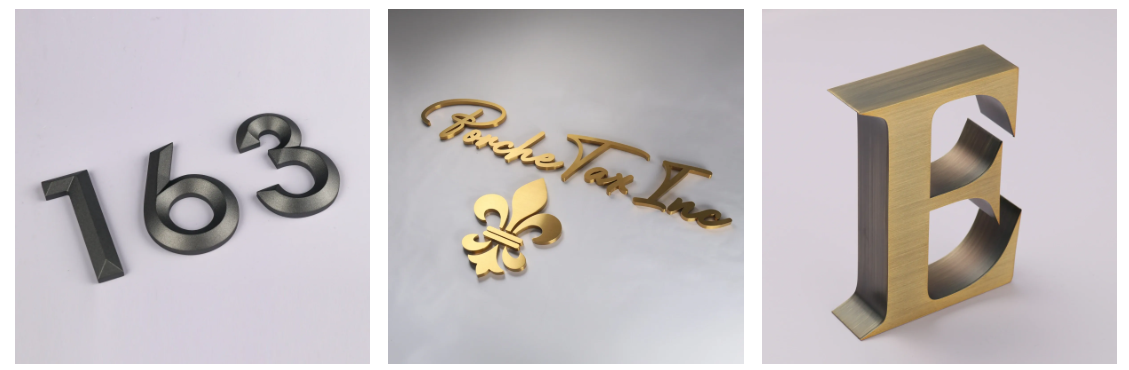
Freestanding stainless steel letters often require protection for both the letter face and the base plate. The base must be secured to prevent pressure against the polished letters during transport.
Wall-mounted metal letters may require individual slots or foam layers. This prevents characters from rubbing against one another.
Large non-illuminated signs may demand a reinforced crate to prevent bending. If the sign includes threaded studs, spacers, or hardware, these items should be packaged and clearly labeled.
Plaques and flat sign panels require protection on their face, back, corners, and edges. If the panel features a brushed, painted, or mirror finish, a soft contact layer is essential.
River Stone’s non-illuminated signs can be customized in terms of size, material, thickness, finish, and mounting method. Consequently, the crate must be planned in accordance with the final product structure.
Clear Labeling Facilitates Safe Shipment Arrival
Effective packaging encompasses more than wood and foam; clear labeling is also crucial.
A crate should display handling symbols such as "Fragile," "This Side Up," "Keep Dry," and lifting points where applicable. For larger projects, each crate should also bear a unique number or project identifier.
This enables warehouse personnel, freight forwarders, customs brokers, and site teams to rapidly identify cargo. It also reduces the likelihood of mishandling or missing components.
For multi-site projects, crate labels can specify store number, room name, sign type, or installation area. This allows site teams to efficiently sort signs upon arrival.
The Significance of Documentation and Packing Lists
For international signage shipments, documentation forms an integral component of the protection strategy. A detailed packing list assists the buyer in verifying goods upon delivery.
The packing list should delineate the crate number, product name, quantity, dimensions, gross weight, net weight, and package measurements. If hardware is included, it should also be itemized.
Pre-shipment photographs are also valuable. They can document the finished sign, internal packaging, sealed crate, labels, and crate condition prior to pickup.
In the event of a claim for transit damage, these records can assist in determining when and where the issue may have transpired.
Guidance for B2B Buyers in Preparing for Shipment
Buyers can enhance shipping safety by proactively sharing key project details.
Initially, confirm the shipping method, whether sea freight, air freight, express courier, or truck delivery. Subsequently, confirm the delivery address, unloading conditions, and the availability of a forklift.
Next, inform the supplier of any site-specific constraints, such as a small elevator, narrow entrance, indoor delivery regulations, or stringent delivery timelines. This can influence crate dimensions and packaging methodology.
Additionally, request packing photographs before shipment. This provides a clear record and aids your team in preparing for receipt.
The Advantages of Partnering with River Stone
River Stone manufactures custom signage for commercial and architectural projects. Our product portfolio encompasses stainless steel lettering, freestanding metal characters, plaques, wall signs, storefront signs, and non-illuminated signage.
Each sign can be fabricated to align with the client’s design, dimensions, typography, material, finish, and mounting requirements. Simultaneously, packaging can be planned around the final product shape and shipping route.
For B2B buyers, this approach mitigates risk during international signage shipping and supports a more streamlined project from production to installation.
Frequently Asked Questions
Why is a wooden crate preferable to a cardboard carton for shipping signage?
A wooden crate offers superior external protection and structural support. It is better suited for heavy, large, polished, or high-value custom signs, particularly for ocean freight and long-haul transport.
Can wooden crating eliminate all shipping damage?
No packaging can eradicate every risk. However, a custom wooden crate can significantly reduce common issues such as impact damage, abrasion, bending, corner damage, and surface scratches.
Is a wooden crate necessary for ocean freight?
In most B2B signage projects, yes. Ocean freight involves longer transit periods and more handling steps. A wooden crate helps protect the sign throughout loading, port transfer, vessel movement, and final delivery.
What should be included in the packing list?
The packing list should include crate number, product name, quantity, dimensions, package measurements, gross weight, net weight, and hardware details, if applicable.
Should I request packing photographs before shipment?
Yes. Packing photographs are useful for verifying the sign, internal protection, crate condition, labels, and package details prior to pickup. They also prove beneficial if a shipping claim becomes necessary later.
Conclusion
Custom signage requires meticulous packaging, as the product is often large, heavy, polished, or manufactured to exact brand specifications. A custom wooden crate helps protect signs from impact, movement, moisture, and transit damage during ocean freight and long-haul delivery.
For international signage shipping, robust crating is more than just packaging; it is an integral part of the overall project plan. With the appropriate crate, clear labeling, and complete documentation, B2B buyers can receive their signs with greater confidence and fewer delays.
Share to:


